

Why it matters
The threat and the response move at different speeds, and that gap now has an operational cost.
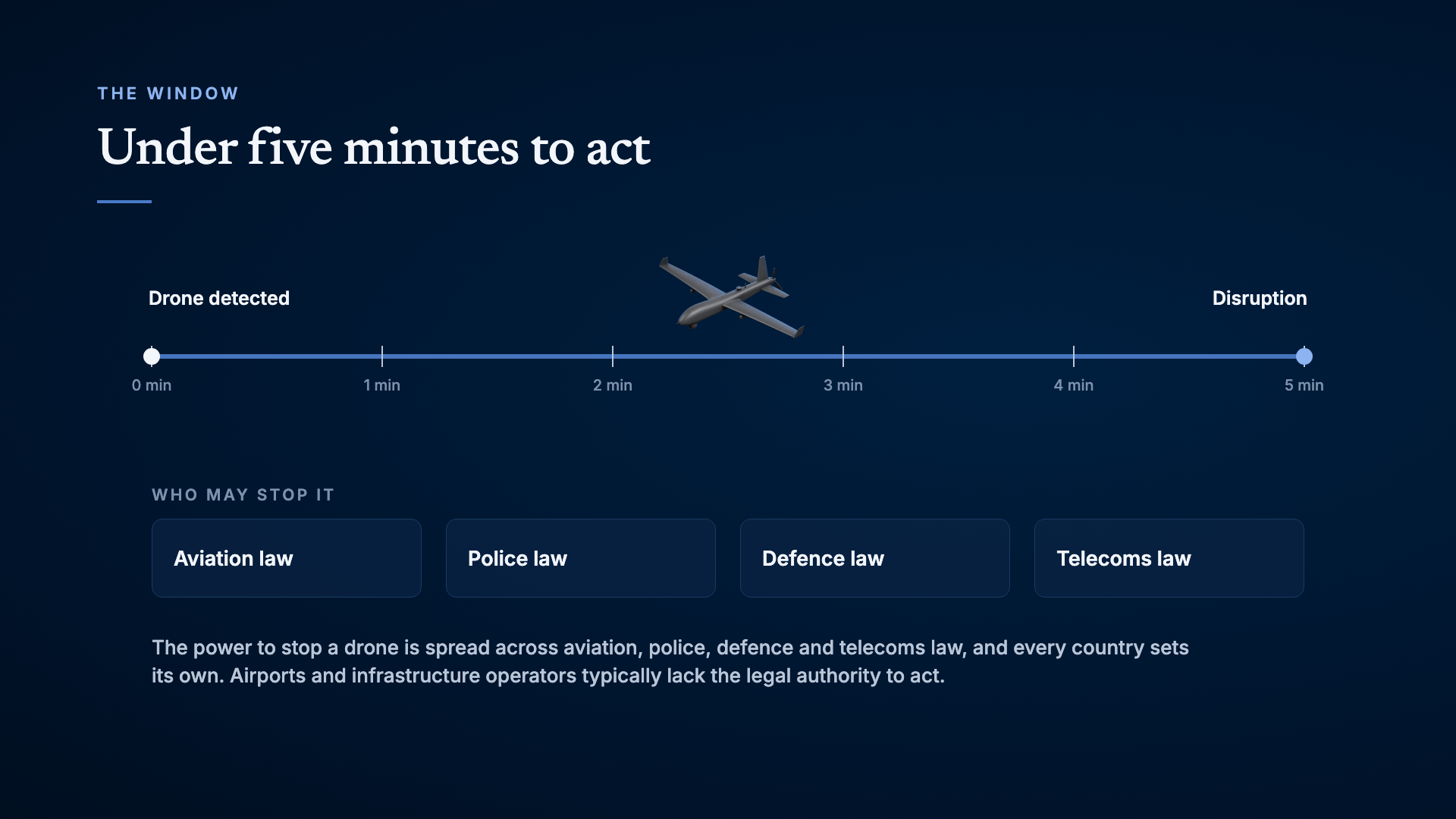
At a European airport, the time between detecting a drone and disruption is under five minutes. Many airports have neither the legal authority to act inside that window nor a chain of command fast enough to reach someone who does.
Drone disruptions at European airports more than tripled between January 2024 and November 2025. Belgium reportedly had a certified counter-drone police unit during airport shutdowns, and asked NATO allies for help instead.
Two layers, one proposal
Europe's drone problem has two layers. Below sit hybrid attacks under the threshold of war, often with deniable origin. Above sits the coordination of national, EU and NATO tools, which the ECFR calls a "hotch-potch".
The new protocol sits between them. It creates a place to meet, and leaves open who can fire, jam or neutralise a drone, in which airspace and under whose command. Those answers stay national until 2030 at the earliest.
flowchart TD
  A[Hybrid attack below the threshold] --> B[Emergency Security Protocol]
  B --> C[All 27 governments meet]
  C --> D{Who may act?}
D --> E[National rules until 2030]What does the five-minute window measure?
How long an EU meeting takes to convene
The time between detecting a drone at an airport and disruption
How long a drone can stay in the air
It is the time between detecting a drone at an airport and the disruption it causes, and many airports cannot get a decision inside it.
Sources
Inside Unmanned Systems: Europe must upgrade its counter-drone strategy now
Unmanned Airspace: IISS report on Russia's drone campaign against Europe
ECFR: Buzzkill, how to defend Europe against drones (18 Aug 2026)
European Commission: Action Plan on Drone and Counter-Drone Security (11 Feb 2026)
European Parliament Research Service: Drones and new systems of warfare782599_EN.pdf)
Breaking Defense: EU chief calls for new hybrid response protocol (16 Sep 2026)